Detection You Can Trust.
Our Approach to Privacy.
How threat detection can work without facial recognition or invasive surveillance — and why the future of safety is better boundaries, not more cameras.
The fastest way to lose trust in safety technology is to make people feel like the technology is watching them.
That is the line schools, hospitals, venues, and public facilities have to get right. People want protection. They want faster response. They want someone to know when something dangerous is happening.
But they do not want a watchlist. They do not want their children profiled. They do not want every face turned into an identity record. They do not want technology quietly deciding who looks suspicious. They do not want safety to become a permanent feeling of being monitored.
That tension is the future of safety. The question is no longer whether technology can make cameras more useful. It can. The harder question is whether safety systems can become more aware without becoming more invasive.
At Previzion, we believe the answer is yes. The principle is simple:
The trust problem hiding inside "smart security"
Most people do not object to safety. They object to not knowing what is being collected, how it is being used, who can see it, how long it is kept, and whether it could be used against them later.
That is why privacy is not just a legal issue. It is an adoption issue.
A school can install the most advanced safety technology in the world and still fail if students, parents, teachers, and staff believe the system is there to monitor them rather than protect them.
Trust is not created by saying, "Trust us." Trust is created by architecture.
- What does the system look for?
- What does it ignore?
- What does it store?
- Who can access it?
- What does it never do?
- How can a school explain it clearly to families?
Those are not vague promises. They are design choices.
The trust line
Which system would you trust more?
Watches people.
- Identifies faces
- Tracks individuals across cameras
- Builds profiles
- Searches for watchlist matches
- Flags individuals for follow-up
Watches for events.
- Looks for defined visible events
- Sends location-aware alerts
- Does not identify people
- Does not build student profiles
- Keeps humans in charge of judgment
That is the core shift. Safety technology does not have to become identity technology. A camera can help recognize that something is happening without turning everyone in view into a record.
That difference is not cosmetic. It is the difference between surveillance and awareness.
Face recognition is not the same as event detection
People often use one phrase for many different technologies. "Camera analytics." "Smart cameras." "Threat detection." "Facial recognition." "Surveillance." These are not the same thing.
NIST distinguishes between several face-related technologies:
Face detection
Determines whether an image contains a face. Common, low-stakes.
Face analysis
Estimates attributes such as age, gender, or emotion. Increasingly contested.
Face recognition
Compares facial features to images for verification or identification — connecting a face to identity.
That last category is where most privacy concerns become serious. Face recognition can be used to identify, verify, or search a database to find a match. It connects a face to identity.
That is not what schools need to know that a visible safety event is occurring.
- A school does not need every student's identity to detect a fight.
- It does not need a facial-recognition database to recognize unauthorized access.
- It does not need to profile students to alert staff that something visibly urgent requires attention.
The better design question is:
That is where privacy-first detection begins.
The privacy spectrum
Different design choices put a system in very different places on the privacy spectrum.
Identity-heavy choices
- Face matching against a database
- Persistent watchlists
- Student or staff profiles
- Continuous person tracking
- Emotion or intent claims
- Broad, default data retention
Event-focused choices
- Defined observable events
- Location-aware alerts
- Human review of every action
- Role-based access
- Limited retention by default
- No facial-recognition database, no student profiling
Privacy is not the opposite of safety
A common mistake is to treat privacy and safety as opposing values. That framing is too small. Privacy is part of safety.
A student who feels constantly watched may not feel safe. A teacher who does not understand how the system works may not trust it. A parent who worries that footage could be misused may resist adoption even if the intention is good.
Real safety includes physical safety, emotional safety, procedural fairness, and community trust. A system that improves one while damaging the others is not complete.
This is why privacy-by-design matters. NIST's Privacy Framework describes privacy risk management as a way for organizations to build innovative products while protecting individuals' privacy. NIST's broader work on trustworthy technology also emphasizes that trust must be designed, evaluated, and managed — not simply claimed.
For schools and public spaces, privacy is not an afterthought. It is a product requirement.
What Previzion does — and what it does not need to do
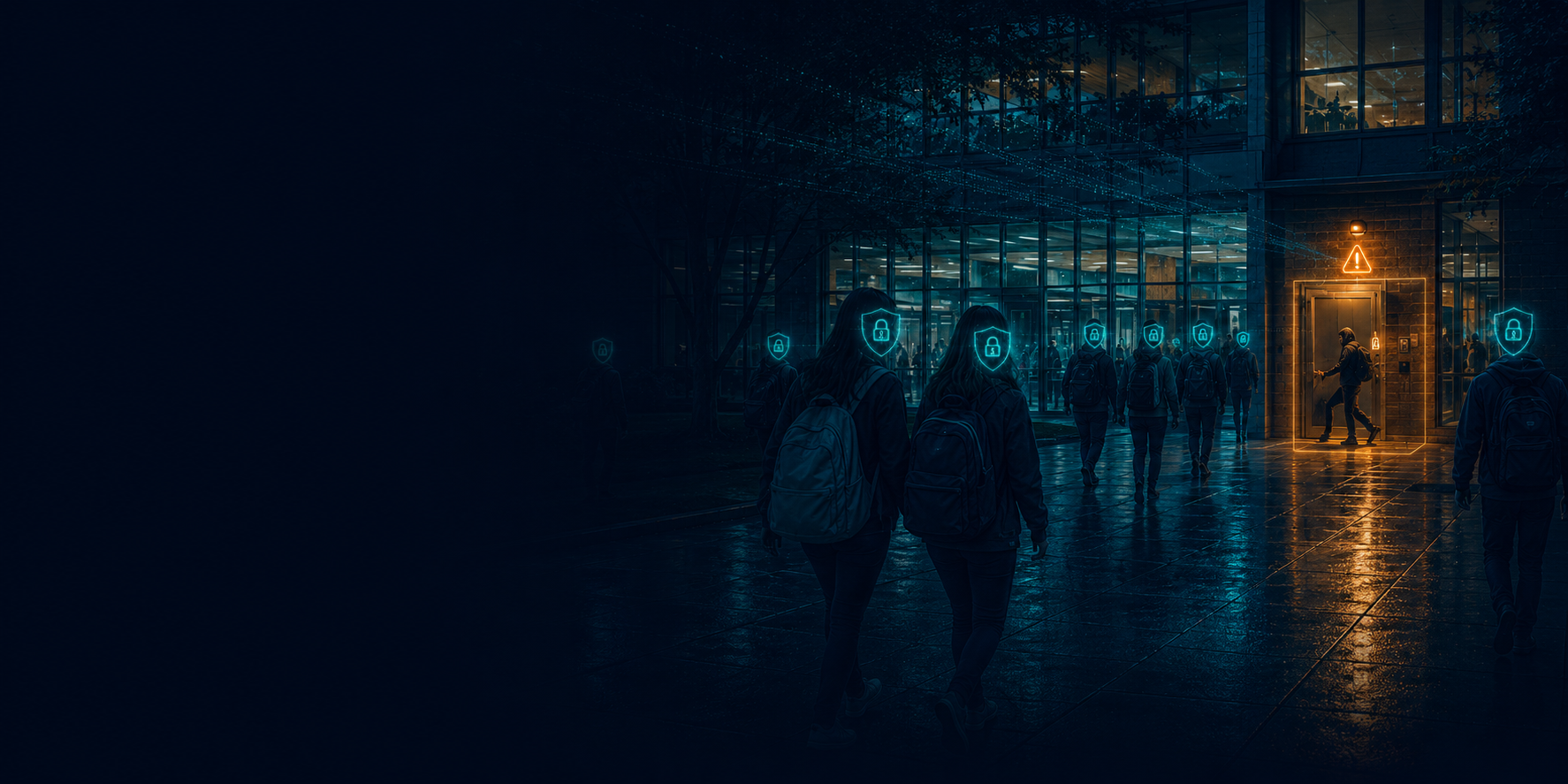
Previzion's role is focused. It connects to existing IP cameras, analyzes connected feeds for defined observable safety events, and routes alerts with location, event classification, and live camera access — in under three seconds, with no facial-recognition databases and no student profiling.
That is the important boundary. Previzion does not need to:
- Know who everyone is.
- Build a biometric database.
- Create a student risk score.
- Infer personality, intent, beliefs, or emotional state.
The value is simpler and stronger:
That is safety without the watchlist.
The data-minimization test
Here is a useful question for any safety technology:
Run three scenarios through that filter:
A person appears to be entering a restricted mechanical room after hours.
A fight appears to begin in a hallway.
A person is down near the gym entrance.
Video is sensitive even when it is useful
Schools already handle video carefully because video can become part of student records depending on context.
The U.S. Department of Education's student-privacy guidance explains that a photo or video may be an education record under FERPA when it is directly related to a student and maintained by an educational agency. Whether a student is directly related to a video is context-specific — examples include surveillance footage used for discipline and video showing a student experiencing a health emergency.
This does not mean schools cannot use video for safety. It means schools should treat video governance seriously:
- Who can view it?
- When is it retained? When is it deleted?
- When does it become part of a student record?
- How are parents' rights handled?
- How are other students' privacy interests protected?
- How are vendor responsibilities documented?
The privacy conversation is not theoretical. It is operational. A privacy-first detection platform should support a school's need to govern footage responsibly — not make the governance problem harder.
The "creep factor" is a design signal
People sometimes dismiss privacy concerns as emotional. That is a mistake. Discomfort can be a useful design signal. When a system feels creepy, it is often because people do not understand its boundaries — or because the system actually does not have clear boundaries.
Watches people.
Hides what it does.
Collects more data just because it can.
Produces secret scores.
Makes people wonder, "Am I being judged?"
Watches for defined events.
Can be explained in one sentence.
Collects only what supports a legitimate safety purpose.
Routes observable context to accountable humans.
Makes people understand, "This is here to help when something happens."
The parent meeting test
Before a school adopts any safety technology, leaders should imagine explaining it at a parent meeting — not in technical terms, in plain language. Can you say:
- We are not using facial recognition.
- We are not building student profiles.
- We are not tracking students across campus.
- We are not using the system to judge personality, emotion, or intent.
- We are using existing cameras to detect defined visible safety events.
- When a possible event is detected, designated staff receive an alert with location and live camera context.
- Humans remain responsible for review and response.
- Access is limited. Use is documented.
- Retention is governed by school policy and applicable law.
If leaders cannot explain the system clearly, the system is not ready for community trust. The parent meeting test is one of the simplest privacy audits a school can run.
What smart buyers should ask
A polished demo is not enough. Schools, hospitals, venues, and public facilities should ask every safety technology provider direct questions:
Do you use facial recognition?
If yes, what database is used, who is enrolled, who approves enrollment, and how can someone be removed?
Do you create identity profiles?
If yes, what data is stored, for how long, and who can access it?
Do you track individuals across cameras?
If yes, for what purpose and under what policy?
What exactly does the system detect?
The answer should be specific. "Threats" is not enough.
What does the system not detect?
Trustworthy providers should be clear about limits — in writing.
Can humans review alerts before major action?
The system should support decision-making, not replace it.
What data is retained?
Ask about video, metadata, alert history, logs, screenshots, clips, and model-improvement data.
Can we configure retention by policy?
Different institutions have different obligations.
Who has access?
Look for role-based access, audit trails, and administrative controls.
Can we explain this to students and families?
If the answer is no, that is a trust problem.
The trust stack
A modern safety platform should have a trust stack just like it has a technology stack.
Purpose limitation
The system should have a clearly defined safety purpose.
Event focus
Identify defined observable events, not profile people.
Human authority
The system should alert and inform. People should decide and act.
Data minimization
Collect and retain the least amount of information required.
Role-based access
Only the right people should see sensitive information.
Transparency
The institution can explain what the system does and does not do.
Auditability
Logs of alerts, access, changes, and reviews.
Retention discipline
Data should not live forever by default.
Review & improvement
The system should be tested, evaluated, and governed over time.
Community trust
Safety technology should strengthen confidence, not create suspicion.
This is how privacy becomes practical. Not a slogan. A set of design choices.
Score your own trust stack
For each item below, score your current system from 0 to 2 — 0 = not in place, 1 = partially in place, 2 = clearly in place.
- We can explain exactly what our system detects.
- We can explain what it does not detect.
- We do not use facial recognition.
- We do not create student profiles.
- Alerts go to defined roles.
- Access is role-based.
- Retention is documented.
- Parents and staff can understand the policy.
- False alerts are reviewed.
- The system is tested and audited.
How to read your number.
The future is not more surveillance. It is better boundaries.
The easy future is cameras everywhere, data everywhere, identity everywhere. That future will fail because it asks communities to accept safety at the cost of dignity.
The better future is more disciplined.
- It uses technology to reduce delay without expanding identity tracking.
- It makes cameras more useful without making people feel watched.
- It detects visible events without building watchlists.
- It routes urgent context without turning every student into a data point.
- It gives trained people more time to act without taking judgment away from them.
That is the future Previzion is building toward.
The leadership question
Every organization adopting safety technology should ask one question before all others:
The answer depends on design. If a system identifies people, tracks identities, builds profiles, and hides its logic, it may increase surveillance faster than safety. If a system focuses on defined visible events, limits data collection, routes alerts to accountable humans, and avoids facial recognition, it can help close the gap between what cameras capture and what responsible teams know.
That is detection you can trust. Not because it is invisible. Because its boundaries are visible.