Your School Has Cameras.
Does It Have a Safety System?
The next era of campus safety is not more hardware. It is a practiced chain from early awareness to coordinated action.
A camera can capture the first second of an emergency in perfect detail — and still do nothing to change the next thirty.
That is the uncomfortable truth behind many school security investments. The cameras work. The footage exists. The incident is visible. But nobody with the authority to act knows about it yet.
The United States does not have a shortage of school cameras. In 2021–22, 93% of public schools reported using security cameras, up from 61% in 2009–10. During that same school year, 96% had written procedures for an active-shooter scenario, and 96% had conducted a lockdown drill.
Those numbers tell us something important. The individual components of campus safety are increasingly common. The next challenge is connecting them.
A school may have cameras, controlled entrances, visitor badges, radios, an emergency operations plan, a threat-assessment team, drills, and relationships with first responders. But having all the pieces is not the same as having a system. A system exists only when those pieces work together quickly, predictably, and under pressure.
A camera is an asset. A safety system is a sequence.
The easiest way to understand the difference is to think about what happens after something becomes visible.
A person enters a restricted area. An altercation begins in a hallway. A visually apparent weapon appears in a parking lot. A crowd suddenly moves in the wrong direction.
The camera may capture the event immediately. But then what?
- Does someone have to be watching that exact feed?
- Does an employee have to notice, interpret, and report what they saw?
- Who receives the report? Does that person know the exact location? Can they see the live feed?
- Who has the authority to initiate the school's approved protective action?
- What happens when the principal is off campus, the school resource officer is helping somewhere else, or the event occurs during an evening basketball game?
These are not camera questions. They are system questions.
A functioning safety system creates a dependable sequence:
When any link in that chain is missing, a sophisticated camera network can become little more than an evidence archive.
Federal emergency-planning guidance takes a similarly broad view. It organizes preparedness around five connected mission areas: prevention, protection, mitigation, response, and recovery. CISA's school physical-security guidance also emphasizes layered measures that help organizations detect, delay, and respond to threats rather than relying on a single product or barrier.
That is the foundation of layered safety. Not a wall of products. A chain of actions.
The real safety gap is often between awareness and action
Schools have historically treated cameras as a forensic tool. Something happens. Staff respond. Later, administrators review the footage to understand who was involved, where the incident began, and how it unfolded.
That function remains valuable. But it begins after the event has already demanded attention.
A modern safety system asks a different question:
That does not mean a camera should determine intent, identify "dangerous people," or independently make disciplinary decisions. A camera cannot understand a grievance. It cannot reliably determine whether a person is angry, frightened, joking, confused, or planning violence. It should not label a student based on appearance, identity, facial expression, disability, posture, or clothing.
What it can do is provide immediate visual context when something observable happens. The distinction is critical:
Is something happening that requires qualified human attention?
- Focuses on observable, defined occurrences
- Surfaces context, not conclusions
- Routes to a person who can decide
- Defensible, auditable, and proportionate
Who should we be suspicious of?
- Drifts toward profiling by appearance or identity
- Confuses judgment with surveillance
- Damages trust in the school community
- Hard to govern, easy to misuse
The second approach is more useful, more defensible, and more consistent with a healthy school environment. Technology should help schools recognize events. People should retain responsibility for understanding context and deciding what to do.
What a genuinely layered school safety system looks like
A strong system is not built around a single emergency. It supports everyday safety while remaining ready for rare, high-consequence events.
Federal school-planning guidance recommends an all-hazards approach — planning for the entire school community and for incidents that can occur before, during, or after the school day, both on and off campus. The Department of Education also stresses multidisciplinary planning, trained staff, coordination with first responders, and accommodations for students with disabilities and English learners.
In practical terms, a layered system has six connected parts.
A culture that reports concerns
Simple, trusted reporting methods. People learn what to report — observable facts, not feelings about someone — and trust that it will be handled proportionately.
A campus designed to create time
Controlled entrances, locks, lighting, visitor management, and environmental design. The job isn't to feel like a fortress — it's to slow movement into sensitive areas.
Real-time visibility into observable events
Connected cameras surface defined events — visible weapons, altercations, unauthorized access — with location and live context. Not automated judgment. Faster handoff.
Clear decision rights, on any day
Every critical role has a primary owner, a backup, and an escalation path. Awareness without authority to act is just a notification.
Messages that move faster than confusion
Radios, mobile alerts, signage, PA, text. Subs, drivers, coaches, custodians, contractors, visitors — everyone gets the message in a channel they actually use.
Drill, review, and improve — in a loop
Tabletops, functional tests, age-appropriate drills with advance notice. After-action review is where the system actually changes. Without it, an exercise is just a performance.
Each layer matters. None of them stand alone. The strongest schools build the connective tissue between them.
Try the 7:12 p.m. test
A basketball game is underway. The principal has gone home. The front office is closed.
The campus has students, coaches, spectators, custodians, officials, and volunteers — but far fewer administrators than during the school day. A person carrying what appears to be a weapon crosses an exterior area covered by a school camera.
Now ask the eight questions that reveal whether your school has camera coverage — or system coverage.
Does that camera merely record the person, or can the event be surfaced for attention?
Who receives the first alert after normal school hours?
Does the recipient receive an exact location and current visual context?
Who has the authority to begin the school's approved protective procedure?
How are the gym, parking area, nearby buildings, and arriving families notified?
What happens if the primary recipient does not acknowledge the alert?
Can responding officers identify the correct entrance, camera, and route without relying on a panicked verbal description?
Does the system preserve enough information for an after-action review without retaining unnecessary personal data?
If the answer to several of these is "someone would probably notice," "the principal would decide," or "we would call around," the school has camera coverage.
Stop measuring camera count
Camera count is easy to measure. It is also a poor measure of readiness. A district can add twenty cameras and still leave the most important operational questions unanswered.
Instead, leaders should measure the performance of the entire awareness-to-action chain.
Time to awareness
From an observable event appearing to a responsible person receiving useful information.
Time to acknowledgment
From alert delivery to someone accepting responsibility for reviewing it.
Time to protective action
From acknowledgment to the start of an approved school procedure.
Alert delivery reliability
Percentage of intended recipients who actually receive and acknowledge alerts during tests.
Critical-zone coverage
Do priority entrances, corridors, gathering spaces, and exterior approaches have usable — not just nominal — coverage?
Decision readiness
Can staff explain what they are authorized to do without searching through a binder?
Add a seventh, harder one: improvement closure. What percentage of issues found during exercises are assigned, corrected, retested, and formally closed? That number reveals whether your safety practice is a system or a paperwork ritual.
Where Previzion fits
Previzion is not a replacement for a school's emergency operations plan. It is not a threat-assessment team. It does not replace trained staff, strong school climate, reporting systems, access control, mental-health resources, emergency communication, first responders, or human judgment.
Its role is narrower — and valuable precisely because it is narrow.
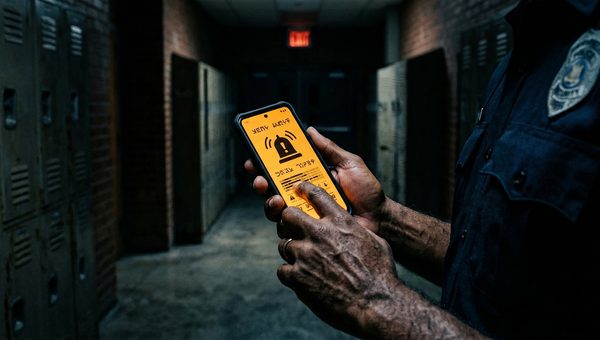
Previzion is designed to turn existing IP cameras into a real-time visual-awareness layer. The platform analyzes connected camera feeds for defined observable events, sends alerts in under three seconds, and provides recipients with location, threat classification, and live camera access. It works with the IP cameras already on site — with no facial-recognition databases or student profiling.
That means Previzion can help close a specific gap:
Consider the difference.
- In a conventional setup, a fight begins outside the cafeteria. The event is recorded, but staff learn about it when a student runs to find an adult.
- In a real-time awareness model, the visible event can be surfaced with its location and camera context so designated personnel can evaluate it and respond according to school policy.
- In a conventional setup, a person enters a restricted exterior area after hours. The footage may be reviewed the next morning.
- In a real-time awareness model, authorized personnel can receive information while the event is still unfolding.
Previzion does not guarantee prevention. It cannot determine a person's intent, and it should not make final decisions about discipline or emergency action. Its value is earlier, location-aware information for the people who already have those responsibilities.
A practical 90-day path from cameras to a system
Schools do not need to replace every device or redesign the entire campus at once. They can begin by improving one awareness-to-action chain.
Each phase has one rule: map how things actually work, not how they're supposed to work. The hidden gaps are always in the gap between the two.
Questions smart school leaders should ask every technology provider
The market is full of products that promise greater safety. The strongest school leaders evaluate more than a demonstration. They ask:
What precisely can the system detect?
Ask for a written definition of every supported event. "Threat detection" is too broad to evaluate or contract against.
What can it not determine?
A trustworthy provider clearly describes limitations, environmental conditions, and failure modes — in writing.
What evidence supports its performance claims?
How were latency and accuracy measured, in which environments, with which cameras, and how are false positives handled?
What happens after the alert?
Detection that doesn't route usable context into your existing response process just creates another silo.
How does the system behave during an outage?
Power loss, internet loss, camera failure, delayed notifications, backup recipients — how does the system degrade?
Who can access the video and alert history?
Define role-based access, retention periods, audit logs, vendor access, and deletion procedures.
Does it identify people or events?
Schools should understand whether a product uses facial recognition, builds identity profiles, or tries to infer emotions or intent.
How will we know it is improving readiness?
The provider should help establish operational measurements — not just report the number of events processed.
A polished interface is not evidence of a complete safety system. A complete safety system can be explained, tested, measured, and governed.
Build for ordinary days, not only extraordinary ones
One of the biggest mistakes in campus security planning is building everything around the rarest scenario. A system used only for a catastrophic event may be unfamiliar when it is needed most.
A stronger approach creates value during ordinary school operations. Real-time visual awareness can support faster attention to fights, unauthorized access, after-hours movement, and other observable events that already consume staff time and affect the learning environment.
Regular, appropriate use teaches staff what alerts look like, who receives them, how acknowledgment works, when escalation is appropriate, where camera coverage is weak, and which procedures need refinement.
Daily relevance builds operational familiarity. Operational familiarity is what readiness actually looks like on a Tuesday in February — not on the worst day of someone's life.
The future is orchestration, not surveillance
The next generation of school safety will not be defined by cameras with more pixels. It will be defined by systems that can deliver the right context to the right people while an event is still developing.
Event-focused, not identity-focused
Technology should surface observable incidents — not build profiles of students.
Context-rich, not alert-heavy
Recipients need location, time, camera view, and a clear reason for the notification — not just another ping.
Interoperable, not isolated
Visual awareness should complement emergency communication, access control, reporting, responder coordination, and established procedure.
Resilient, not dependent on one person or device
Backup recipients, health monitoring, documented outage procedures, and clear manual alternatives.
Measured, not assumed
Leaders should know whether the technology actually reduces time to awareness — not whether the dashboard looks busy.
Continuously improved, not installed and forgotten
Campus, threats, staffing, and student needs change. The safety system must change with them.
Safety should feel capable, not frightening
A secure school does not have to feel like a school under constant suspicion. Students learn best in environments where they feel known, supported, included, and safe. Federal guidance treats school climate, mental health, reporting, physical preparedness, and emergency response as complementary — not competing — parts of school safety.
The goal should not be to make every student feel watched. It should be to make every responsible adult better prepared.
That means using cameras to understand observable events, not to judge identities. Conducting drills to build competence, not fear. Collecting only the information required for a legitimate safety purpose. And using technology to support human responsibility — not to avoid it.
The future of campus safety is not a school that knows everything about everyone. It is a school that knows what to do when something important happens.
The leadership question
Your school probably has cameras. It may also have written plans, radios, controlled entrances, emergency drills, reporting channels, and strong community partnerships. But the question is not whether those things exist.
The question is whether they form a practiced chain:
- Can the school recognize an observable event?
- Can it deliver useful context to the right person?
- Can that person act without delay or ambiguity?
- Can every member of the community receive and follow the instruction?
- Can the organization learn from the outcome?
That is the difference between owning security equipment and operating a safety system.
Previzion can help move existing cameras from the evidence layer into the awareness layer — giving trained people earlier, location-specific context while preserving human judgment and established school protocols.