Your Cameras Are Watching. Are They Warning?
A look inside real-time computer vision — and why sub-3-second detection changes outcomes.
The most important security camera in a building is often the one nobody is watching.
That is not a criticism of security teams. It is a design problem. Modern campuses, hospitals, office towers, venues, parking structures, and schools can have dozens or hundreds of cameras. The feeds are live. The footage is clear. The risk may be visible. But visibility is not the same as awareness.
A camera can record everything. A human can only notice so much.
That distinction matters because many threat events move faster than our traditional response model. FBI research on active-shooter incidents found that 60% of incidents ended before police arrived. In the cases where duration could be determined, 69% ended in five minutes or less, and 23 incidents ended in two minutes or less.
So the question for safety leaders is changing. It is no longer, "Do we have cameras?" Most organizations already do — in public schools, for example, NCES reports that 93% used security cameras to monitor the school in 2021–22. The harder question is:
That is where real-time computer vision changes the conversation.
The problem is not seeing. It is noticing.
Humans are extraordinary at understanding context. We can read body language, infer intent, calm a tense situation, and make judgment calls that no algorithm should make alone. But humans are not built to maintain perfect attention across a wall of video feeds for hours at a time.

That is the hidden weakness in traditional surveillance. The camera may capture the critical moment, but the system still depends on a person noticing that moment quickly enough to act. In real-world security environments, operators are managing competing demands: radio traffic, access control, incident reports, fatigue, shift changes, distractions, and dozens of live feeds.
Research on CCTV vigilance has shown that task disengagement is associated with lower detection rates during surveillance monitoring. A separate review of cognitive challenges in CCTV surveillance noted that sustained attention, low-frequency events, distraction, and visual search demands can impair detection performance over time. This is the part most people miss:
Computer vision does not have to be "smarter" than a trained security professional to be useful. It has to be more continuously attentive. The advantage is not judgment. The advantage is persistence.
Computer vision can examine connected camera feeds continuously, frame by frame, without fatigue, distraction, or competing priorities. It can look for specific visual patterns — such as a visible or visually apparent weapon — and route an alert when the system identifies something that requires human review or response.
How computer vision actually spots a weapon
Computer vision does not "see" like a person. It converts video frames into data. A model analyzes shapes, edges, proportions, textures, motion, and spatial relationships. It then assigns probabilities to what appears in the frame.
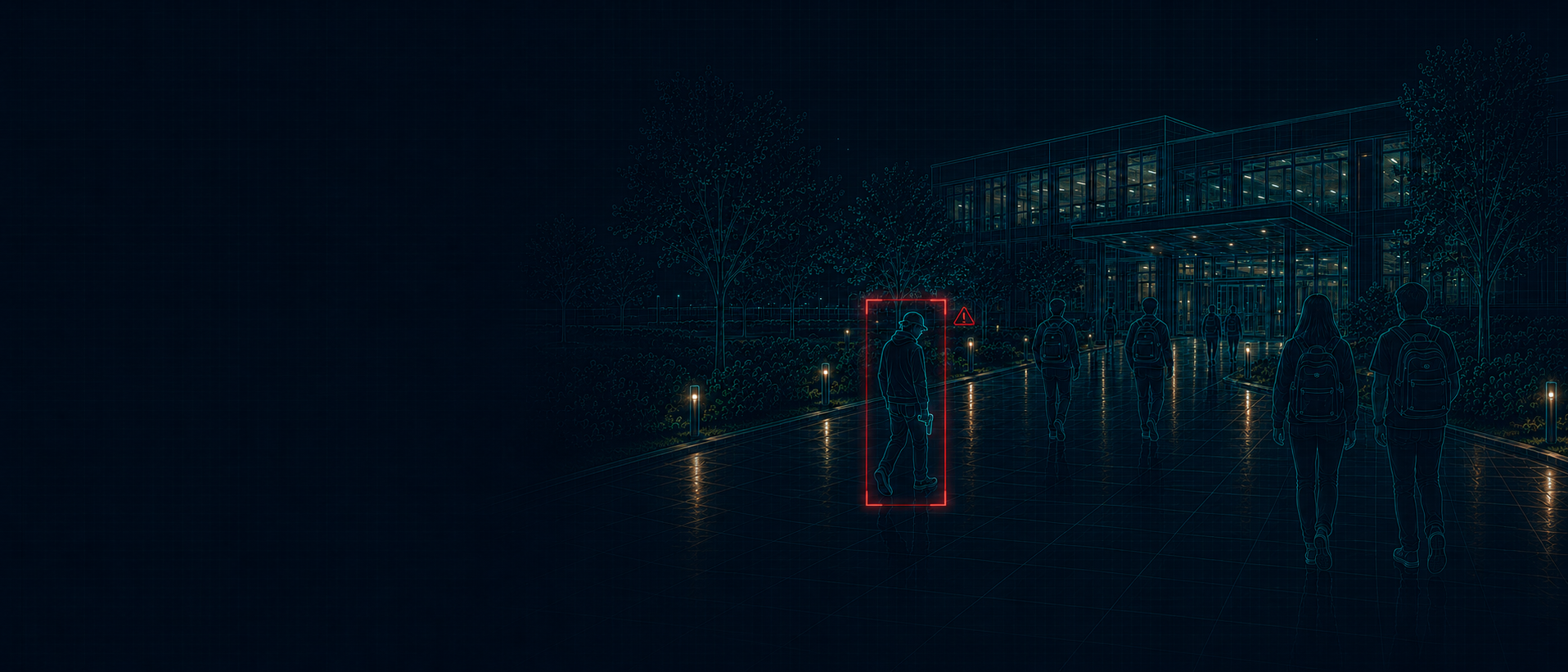
In a real-time object detection pipeline, the system may look at a live camera feed and identify objects by drawing a bounding box around a likely item: a person, a bag, a vehicle, a doorway, or, in this case, a visible weapon.

This category of computer vision became practical because object detection got fast. The original YOLO research paper — "You Only Look Once" — framed object detection as a single neural-network pass that predicts bounding boxes and class probabilities directly from full images. The authors reported that the base YOLO model processed images at 45 frames per second, while a smaller version processed 155 frames per second.
That matters because security response is not a still-image problem. It is a live-video problem. A weapon may appear only briefly. The person holding it may be moving. The camera may be at an angle. Lighting may be uneven. The object may be partially blocked by a hand, jacket, doorframe, crowd, or bag. Weapon detection is difficult because real-world environments are messy.
A 2025 systematic review of computer-vision–based weapon detection research found reported precision ranging from 78% to 99.5%, recall from 83% to 97%, and mean average precision from approximately 70% to 99%. But the same review also warned that inconsistent evaluation criteria, dataset variability, privacy concerns, and limited real-world validation remain major challenges for AI weapon-detection systems.
That is why the best way to understand computer-vision weapon detection is not as a magic "gun detector." It is a speed layer in a larger safety system:
- The model identifies a possible visible threat.
- The system validates the signal across frames.
- The alert is routed with location and camera context.
- Humans decide what to do next.
The breakthrough is not detection alone. The breakthrough is detection connected to action.
Why sub-3-second detection changes the math
Three seconds sounds small until you map the old response chain. Traditionally, a threat becomes visible. Someone has to notice it. Then they have to interpret what they are seeing. Then they have to decide it is serious. Then they have to find a phone, radio, panic button, or supervisor. Then they have to describe the location. Then someone else has to receive the report, verify it, and start the response.
That is not one delay. It is a stack of delays.
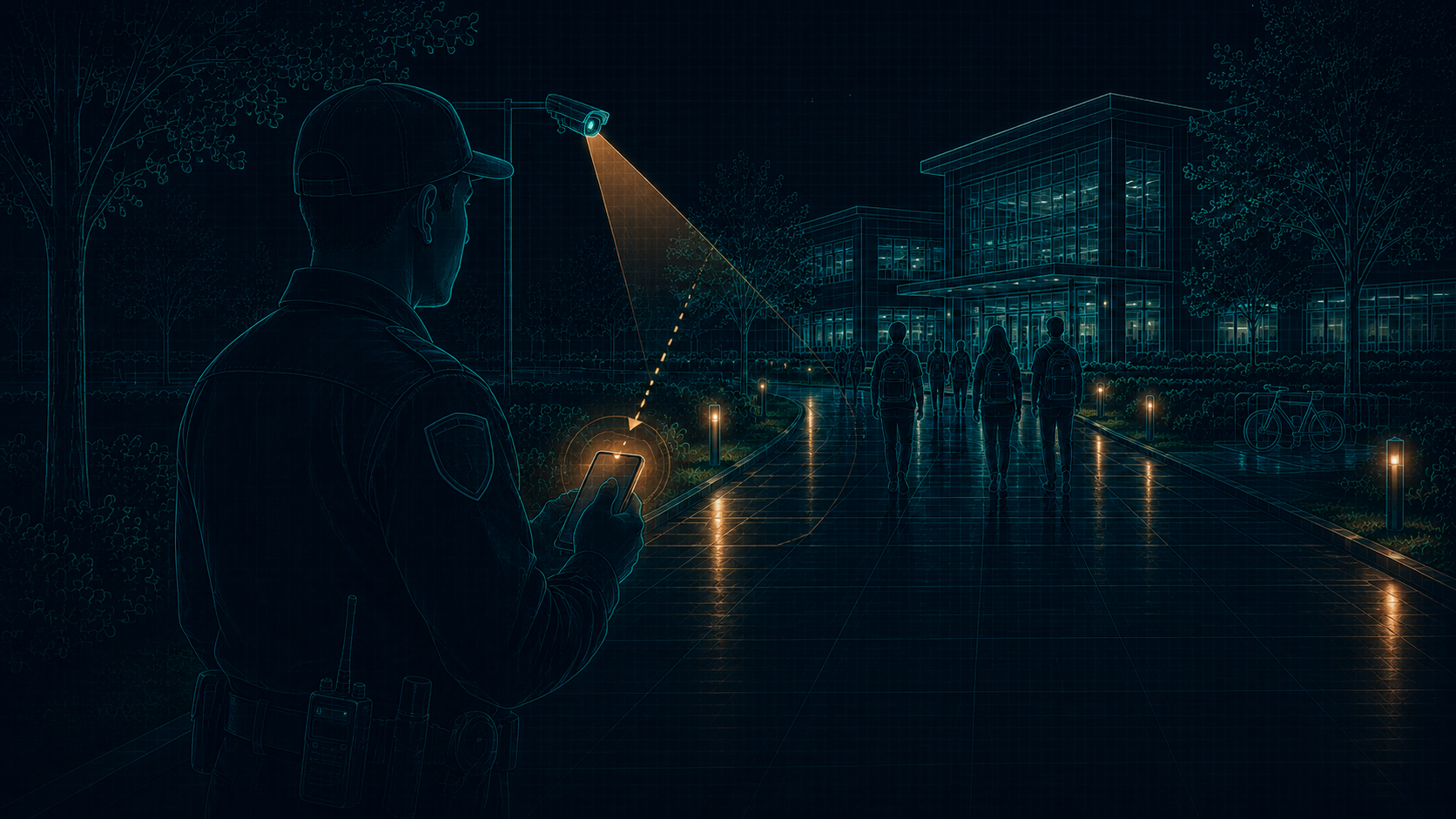
Real-time computer vision compresses the first mile of response. When a visible or visually apparent weapon appears in a camera's field of view, the system can flag the event, attach camera location, provide visual context, and notify the right people far faster than manual monitoring alone.
Previzion's platform is built around real-time alerts to staff and first responders in under three seconds, existing IP-camera integration, location-based push alerts, threat classification, live camera access, and sub-3-second processing latency.
Sub-3-second detection does not guarantee prevention. It does not replace emergency planning. It does not remove the need for trained people, access control, law-enforcement coordination, or clear protocols. But it creates options earlier:
- A hallway can be cleared before confusion spreads.
- A front desk can lock or restrict access before a person reaches a secure area.
- A school resource officer or security team can receive a camera-specific alert instead of a vague report.
- First responders can receive location and live visual context instead of relying only on verbal descriptions from people under stress.
The future is not more cameras. It is cameras that can raise their hand.
For decades, video surveillance has mostly been forensic. Something happened, and later we reviewed the footage. The camera helped answer who was there, where it happened, when it started, and how it unfolded.
That is useful after the fact. But during the first seconds of a threat, after-the-fact evidence is not enough. The next generation of safety infrastructure turns cameras from passive recorders into active sensors — a shift from video archive to real-time awareness.
Previzion is positioned directly in that shift. The platform connects to existing IP cameras, analyzes camera feeds, sends real-time alerts with location and live camera access, and uses a privacy-first architecture with no facial recognition databases and no student profiling.
That privacy point matters. The future of safety cannot depend on making people feel constantly identified, ranked, or tracked. NIST distinguishes between face detection, face analysis, and face recognition. Face recognition compares an individual's facial features to available images for verification or identification purposes — and that distinction is important for leaders evaluating detection tools.
The most trusted systems will not ask communities to choose between safety and dignity. They will focus on detecting dangerous objects and urgent events, not building identity profiles. The goal is not to know who everyone is. The goal is to know when something dangerous is happening.
Detection should be the early-warning layer — not the decision-maker
The wrong way to talk about this technology is to imply that software can solve violence by itself. It cannot. Computer vision does not replace trained staff. It does not replace threat assessment teams, mental health resources, emergency drills, access control, school resource officers, security operations centers, law enforcement, or human judgment.
It also should not be treated as infallible. Lighting matters. Camera placement matters. Occlusion matters. False positives matter. False negatives matter. Model testing matters. Privacy governance matters. The research is clear that computer-vision weapon detection still needs stronger benchmarking, real-world validation, standardized datasets, and privacy-preserving implementation practices.
But dismissing this technology because it is not perfect misses the point. The goal is not perfect automation. The goal is faster awareness.
Computer-vision weapon detection belongs in that category. It is an early-warning layer that turns silent video into actionable intelligence.
The leadership question
The organizations that lead on safety over the next decade will not be the ones with the most cameras. They will be the ones that redesign the time between threat visibility and response.
That is the real innovation behind sub-3-second detection. It changes the unit of safety planning from minutes to moments. A minute is enough time to explain what happened. A moment may be enough time to change what happens next.
Previzion's promise is not that software "solves" violence. The stronger idea is that existing cameras can become part of a living response system — one that detects visible threats, routes critical alerts, and gives humans actionable context earlier than manual monitoring alone. Previzion turns existing cameras into a first-seconds warning layer.
The camera was always watching. Now it can warn us.